
The S-word
Can you belong to the democratic left without being a socialist? A Hungarian reader's case for a different word.

I bought the graphic-novel version of Piketty's Capital and Ideology for a family vacation, mostly because I'd bounced off the original twice and a thousand pages felt like the wrong thing to carry to a beach. Claire Alet adapted it and Benjamin Adam drew it, and they made the choice that saves the project: instead of marching through the data, they follow one French family from the Revolution to the present, eight generations, watching a fortune get built, defended, taxed, and slowly pulled apart. The economics arrives through the family, which is the only reason the economics stays readable.
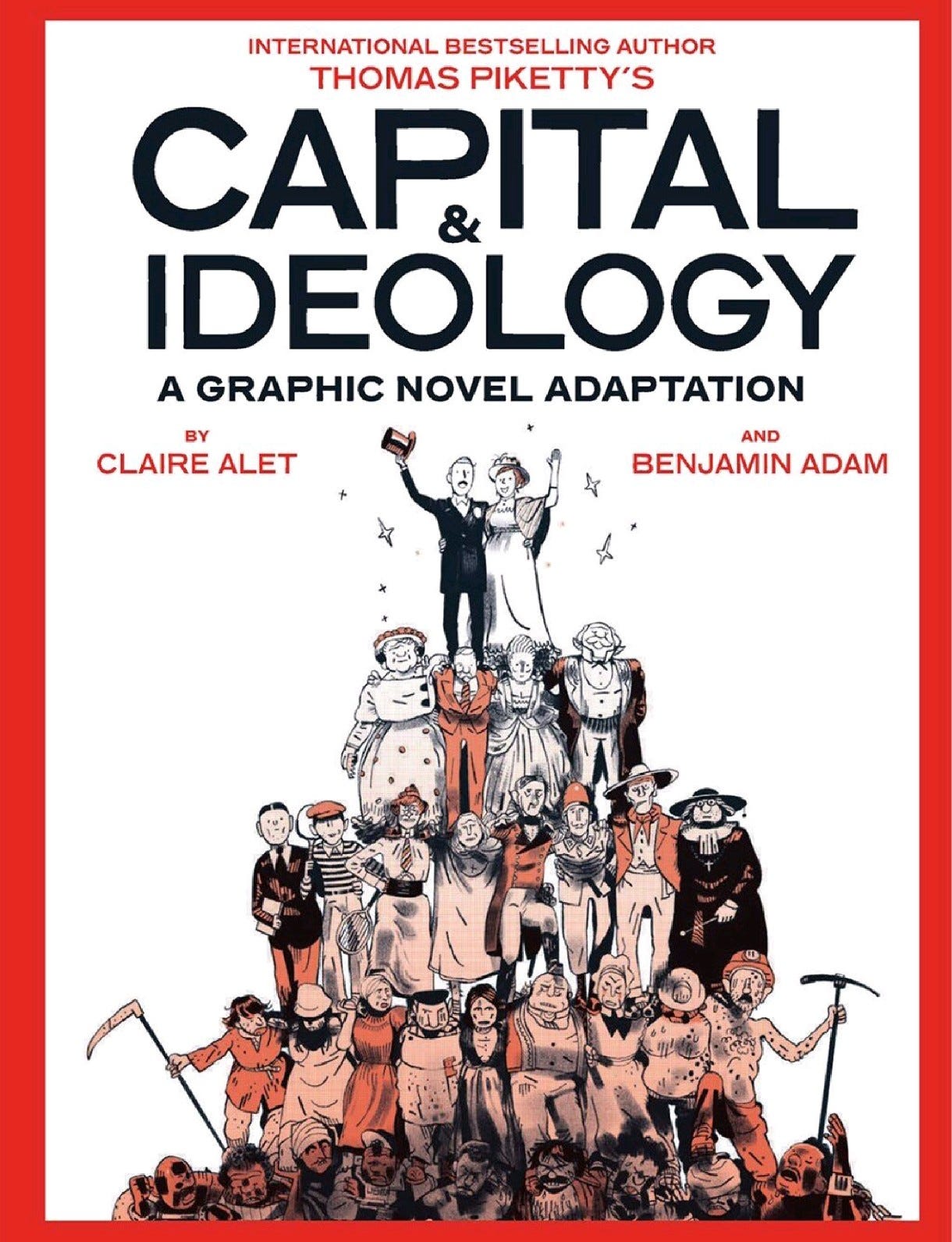
I don't mean that as a concession to the form. I've read enough Joe Sacco to believe comics can do serious journalism, that a drawn panel can carry an argument a spreadsheet cannot. Piketty's numbers are all still here, and they stay sacred. But none of us reads as a neutral instrument, and a story about one family's rise and ruin moves you in a way a Gini coefficient does not.
By the end a lot of it had won me over. The book closes with six proposals Piketty files under "participatory socialism": progressive taxes on wealth and inheritance, a capital endowment so people start adult life with something instead of nothing, real worker representation on company boards, forms of ownership that pass through hands rather than settling permanently into a few. Quarrel with the numbers if you want to. As a direction most of it looks right to me.
Then there's the word.
I grew up in northeastern Hungary, born in the eighties, in what used to be steel country. "Socialism" isn't a slogan or a seminar topic for me, though I should be honest about which part of it I knew. We were not the family with a passport, a car and enough hard currency to shop on Mariahilfer Straße in Vienna; that describes a minority. Most of us lived everyday socialism at ground level, with the West reaching us as rumor and as my parents' talk, a better life close enough to hear about and too far to touch. What we had instead was the local consolation: ours was, in the standing joke, the happiest barrack in the camp, and you were glad to have been born in Kádár's Hungary rather than Ceaușescu's Romania or Hoxha's Albania. The part I watched from close up came later, when the mills that had defined the region stopped defining it, and the people the transition ruined were recast as its "losers" and blamed for losing.
So whenever someone tells me that what we had wasn't real socialism, I think of János Kornai. He spent his working life studying that exact system and refused to write its failures off as bad luck. His 1980 book Hiány, known in English as Economics of Shortage, laid out the mechanism: enterprises ran under a soft budget constraint, able to lose money indefinitely because the state always covered them, and chronic shortage followed as the system's ordinary output, produced and reproduced day after day. Once you've read Kornai, the "not real socialism" defense stops being available, because the man who understood the machine best is the one telling you it ran the way it was built to run.
The other name I keep beside Kornai is Mihály Vajda. He belonged to the Budapest School, the philosophers around György Lukács who set out in the sixties to recover an authentic Marx from the Marxism-Leninism of the state, to get back, as Vajda put it, from official dogma to the real thing. It didn't hold. Most of them left Marxism altogether; the party expelled several of them in 1973 and pushed many into exile. In 1990 Vajda gathered his reckoning into a book that states the matter in its title: Marx után szabadon, avagy miért nem vagyok már marxista (freely after Marx, or why I am no longer a Marxist). Part of what he meant, he explained, was a refusal to let philosophy harden into ideology. His colleagues Heller, Fehér and Márkus had already given the system its most exact name, a dictatorship over needs, a state that settles on your behalf what you are allowed to want. These were the tradition's own believers, insiders who had tried to repair it from within, and they left with their eyes open.
Which leaves the question I keep turning over: can a person stand on the democratic left without being a socialist? Vajda's circle answered it by leaving Marxism without defecting to anything worse. My own answer is the one Piketty pointedly refuses to use: social democracy.
The graphic novel had already sent me back to a thinner book from last spring, another Piketty, this time in conversation with Michael Sandel: Equality: What It Means and Why It Matters, from their 2024 exchange at the Paris School of Economics. Sandel brings the argument I find hardest to shake, the one from The Tyranny of Merit and What Money Can't Buy: that a society which sorts people by "merit" humiliates the ones it sorts to the bottom, and that some goods lose their nature the moment you put a price on them. Piketty adds a point I hadn't expected. The fall of the Soviet Union, he argues, weakened social democracy in the West rather than strengthening the left, and helped open the way to what Sandel calls the commodification of everything.
That is where the word comes apart for me. Put the two books together and look at what is on the table: progressive taxation, a serious welfare state, worker voice inside the firm, public limits on what markets are allowed to buy, capital spread wide rather than pooled. This is the social-democratic tradition, close to its most ambitious form, the Nordic and German settlement pushed well past where either country has taken it. None of it needs the central plan that Kornai spent his life anatomizing. And there is an irony in the naming: the same Piketty who mourns the weakening of social democracy after 1989 will not call his own program by its name.
He declines it on purpose. His case, roughly, is that postwar social democracy made its peace with concentrated ownership, redistributing income at the margins while leaving the core of capitalism intact, and that a bolder program deserves a bolder word. I follow the reasoning. I just think that where I stand, the word he reaches for to signal ambition mostly signals something else.
In Budapest or Warsaw or Bucharest, "socialism" points east, back toward Kornai's shortages and the dead mills of my childhood region. "Social democracy" points west, toward Austria and Scandinavia, toward the ordinary prosperity we could only watch from the wrong side of the border. For a Central or Eastern European the choice of word decides whether the thing on offer reads as a memory of scarcity or as a model you might actually want. And I suspect it reaches past us. Wherever "socialism" got welded to a single-party state, across much of Asia and Latin America as much as here, the same swap would let people hear the proposals before the history drowns them out.
So the answer to my own question is yes. You can stand on the democratic left without being a socialist; millions of people in Vienna and Stockholm have done it for decades. For proposals this good, the goal should be the name that lets people hear them. On my side of the old line, that name is social democracy. Piketty can keep fighting for the other one; I would rather the argument reach the steel towns before the noun does.